
THE BIRD’S-EYE-VIEW
A wider view of the things worth thinking understanding.
The Bird’s-Eye-View is FinchQ’s weekly podcast—exploring topics of interest through a broader perspective on function, independence, technology, health, behavior, aging, and the way we live.
New episodes weekly.
FUNCTION & FREEDOM
Never miss The Bird’s-Eye-View.
Get each week’s Bird’s-Eye-View, plus occasional articles, notes, and important FinchQ updates.
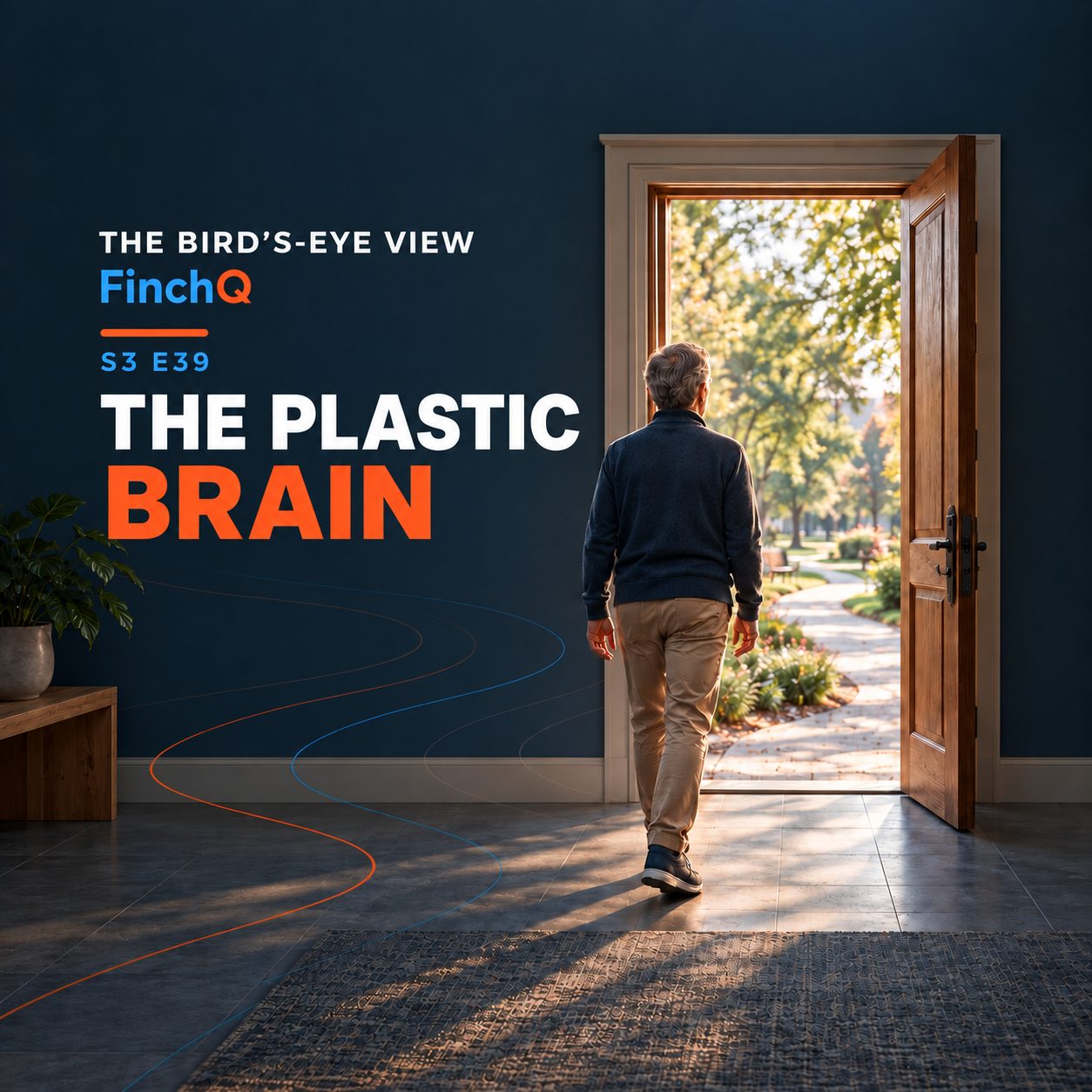
S3 E39 - The Plastic Brain
S3 E39 - The Plastic Brain
The adult brain can still adapt, but familiar routines may offer fewer reasons to learn. In this episode of The Bird’s-Eye View from FinchQ, Jack and Janet Finch explore how a gradually shrinking world can reduce opportunities for challenge, practice, and participation. They examine the article’s research on exercise, demanding new skills, cognitive reserve, and sleep, while keeping the limits of that evidence clear. The central question is practical: what could you learn next, with manageable difficulty and appropriate support?
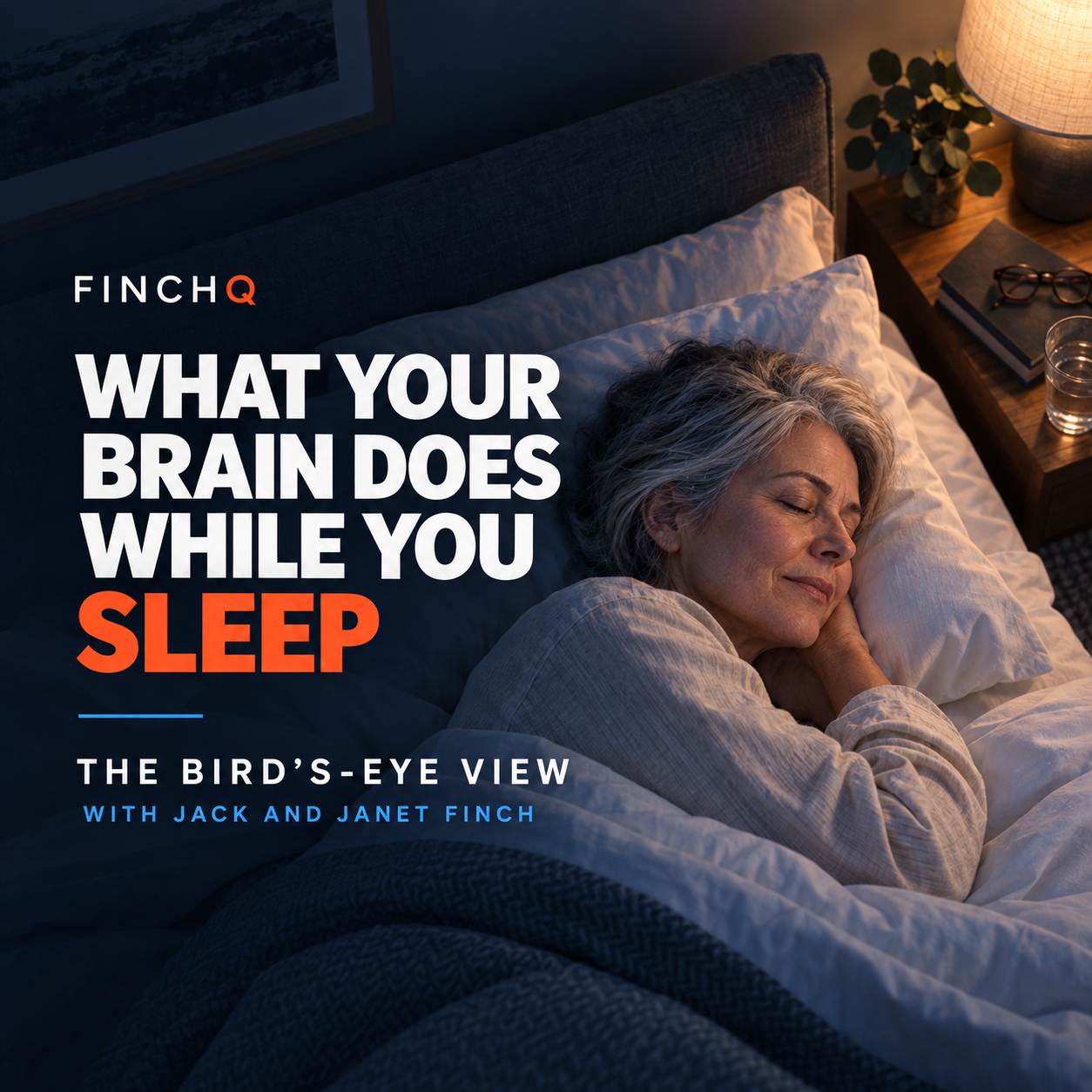
S3 E38 - What Your Brain Does While You Sleep
S3 E38 - What Your Brain Does While You Sleep
A sleeping brain is not an inactive brain. Jack and Janet use the image of a city at three in the morning to explore the hidden work of sleep: changing electrical rhythms, coordinated blood-flow and cerebrospinal-fluid patterns, and the still-evolving science of the glymphatic system. They explain what researchers have learned from animal studies, what human studies suggest about amyloid-beta and tau, and why the strongest conclusions require restraint. This episode replaces the familiar idea of sleep as “doing nothing” with a more accurate one: sleep is a distinct biological state with important consequences for memory, function, and long-term brain health.
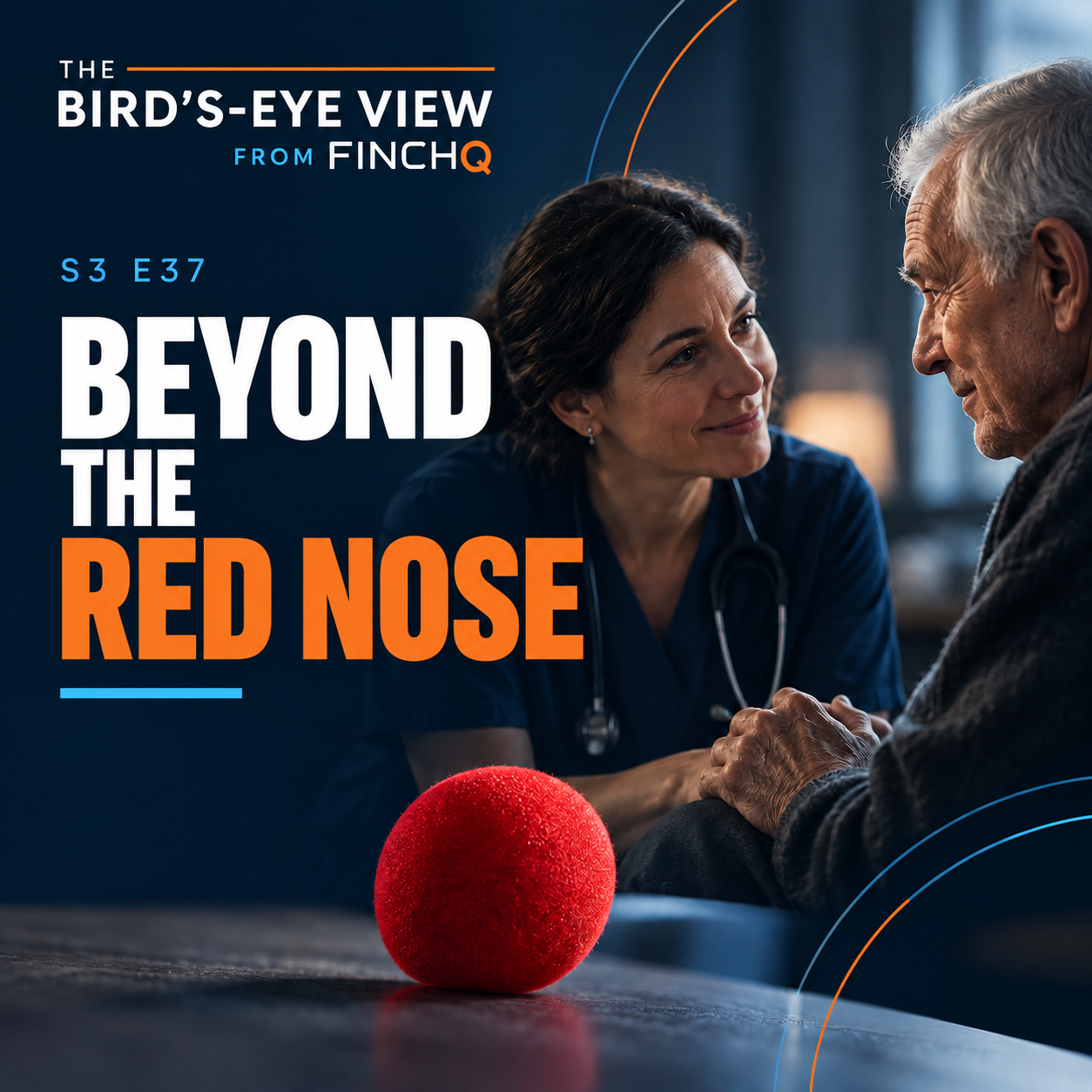
S3 E37 - Medicine Beyond the Red Clown Nose
S3 E37 - Medicine Beyond the Red Clown Nose
Patch Adams is easy to remember: the red nose, the clowning, the movie. But those images can obscure the more radical ideas underneath them. In this episode, Jack and Janet Finch look beyond the familiar caricature to explore Adams's decades-long challenge to conventional healthcare—the importance he placed on time, friendship, play, community, creativity, and genuine human relationships. This isn't an argument that humor cures disease or that every part of his model should be adopted. It is an examination of a harder question: what happens when technical competence remains, but the human relationship at the center of care begins to disappear?
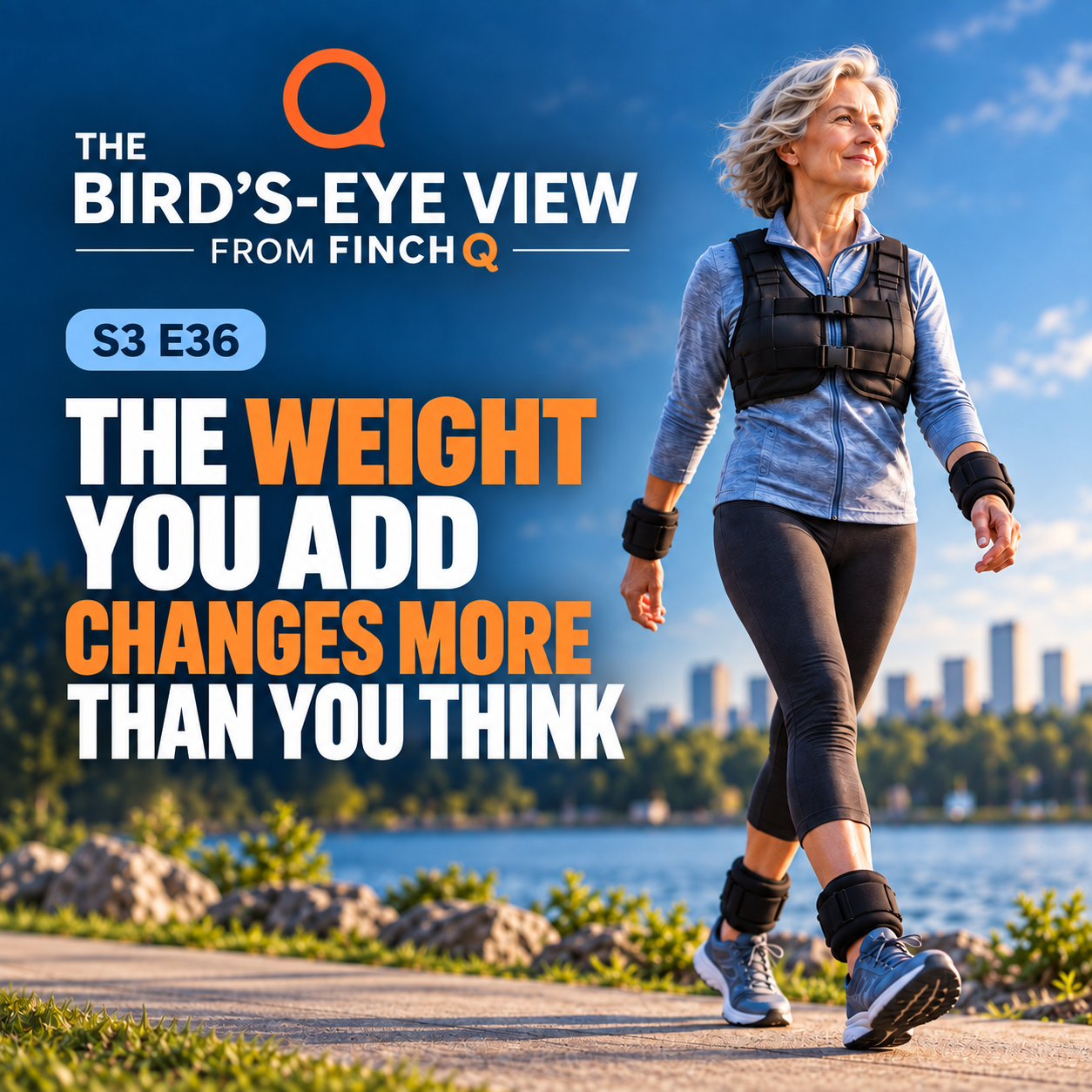
S3 E36 - The Weight You Add Changes More Than You Think
S3 E36 - The Weight You Add Changes More Than You Think
When you strap on ankle weights for a morning walk, you're not just adding resistance—you're changing how your entire body moves. Jack and Janet explore why understanding those movement patterns matters more than feeling like you're working harder, and when wearable weights actually help.
S3 E35 - How Starlight Powers Your Every Move
S3 E35 - How Starlight Powers Your Every Move
Every step begins with an energy story older and larger than the body. In this episode of The Bird’s-Eye View from FinchQ, fictional AI-generated hosts Jack and Janet Finch trace the path from sunlight captured by photosynthesis, through food and cellular metabolism, to ATP and muscle contraction. Along the way, they separate two ideas that are often blended together: the energy that helps us move and the star-forged elements that make up much of the body. The result is a clear, grounded look at the chain of transformations behind an ordinary human movement—and why “powered by starlight” works best as a carefully understood metaphor.
S3 E34 - The Open World of 117 Year Old Ethel Caterham
S3 E34 - The Open World of 117 Year Old Ethel Caterham
A faster walking pace is not the destination. Rome is. The airport gate is. Carrying your own bag, joining the family outing, and continuing to choose where life can take you are the destinations.
In this episode, Jack and Janet explore function as access. Strength, balance, endurance, and mobility matter because they help keep doors open to places, people, participation, and experience. When access begins to narrow, it may happen so gradually that the change is easy to miss: stairs become inconvenient, a trip feels too demanding, or one more invitation is declined.
The conversation also reframes independence. Independence is not the absence of help. A handrail, mobility aid, supportive home, reliable transportation, or connection to other people can preserve independence by protecting meaningful choice.
Finally, Jack and Janet consider the difference between a snapshot and a direction. One difficult day may simply be one difficult day. Repeated observations, interpreted in context, may reveal a pattern—and a pattern can create time to understand, adapt, seek appropriate professional guidance, and act.
S3 E33 - The Real Cost of Your Normal Walk
S3 E33 - The Real Cost of Your Normal Walk
This episode explores how gradual physiological changes and increased physical demands often go unnoticed because the body is remarkably adept at invisible adaptation. While population data shows that modern adults carry significantly more weight than previous generations, their walking speeds have remained consistent, suggesting the body absorbs higher mechanical costs to maintain the same performance. This shift creates a narrowing functional reserve where the relationship between capacity and demand becomes strained over time without being captured by isolated measurements. Because single data points cannot illustrate a downward trajectory, individuals often fail to recognize their own decline until their autonomy is already compromised. Ultimately, it argues that early pattern recognition is the only way to identify these subtle shifts and take proactive steps to preserve long-term independence.